Princeton UMC in the News

In “Faith and Activism: a discussion with three religious leaders in Princeton,  Nora Peachin interviewed  Rev. Lukata Mjumbe (of Witherspoon Street Presbyterian Church), Sohaib Nazeer Sultan (Muslim life coordinator at Princeton University), and Rev. Jenny Smith Walz (Princeton UMC lead pastor), “about the intersection of faith and activism in their own lives, and how they view their responsibilities as religious leaders in the fight against injustice and inequality.”

The article told about Princeton UMC’s  five-day prayer vigil to end racism, closing with a ceremony held on the church lawn. Here is a link to the article, and here are some excerpts:

Participants prayed for an end to systemic racism and for the courage to do anti-racism work. Prayers such as those are also a form of activism. “It moves us on to next steps,” Walz said. “We continue to hear what God invites us to do next.”

The church website provided a list of anti-racism resources that included books, films, organizations, songs, and more.

Her faith underlies everything she does, including her activism, she said. The moral teachings of her religion have compelled her to fight against injustice.

No matter what form it takes, activism is slow work, Walz said. Changing systems, communities, and organizations to eradicate inequality and uplift the vulnerable takes time. “It goes little bit by little bit, relationship by relationship,” she said.

Being a faith leader is about bringing all people together, including those being pushed to the margins economically and culturally, Walz said.

All three (faith leaders) described seeking a fine balance between comforting their congregants and making them uncomfortable by asking them to reckon with their own privilege and bias or acknowledge their complicity in injustice.

“We’re here to comfort the afflicted and afflict the comfortable,” Walz said. She is constantly juggling these dual objectives — offering care, compassion, and support to her members while simultaneously challenging them to better themselves and their communities.

“The deepest struggle for us as Christians is to actually believe we are all God’s beloved children,” she said. “We don’t always believe it with our actions and reflect it in our whole lives. There has to be a certain discomfort to make that change. There’s a way the discomfort is ultimately healing.”

Walz works in a relatively privileged area of Princeton, and was initially daunted by the task of challenging her members to question their own biases and complicity. She knows preaching on oppression will prevent some people from attending her sermons, but said that does not stop her.

“I have to find the courage to know that people aren’t always going to agree,” she said. “I hope I can offer a space for people to learn.”

Princeton UMC Prayer Vigil Culminates in Evening Service

Before May 25, 2020, 8 minutes and 46 seconds was an innocuous span of time.  That changed tragically on the day George Floyd died after being held down  for 8 minutes and 46 seconds by a police officer who ignored his repeated cries of “I can’t breathe.“  On June 9, as a culminating event for its five-day prayer vigil to stop racism, Princeton UMC invited the public to participate in a service of prayer and personal witness against systemic racism. 

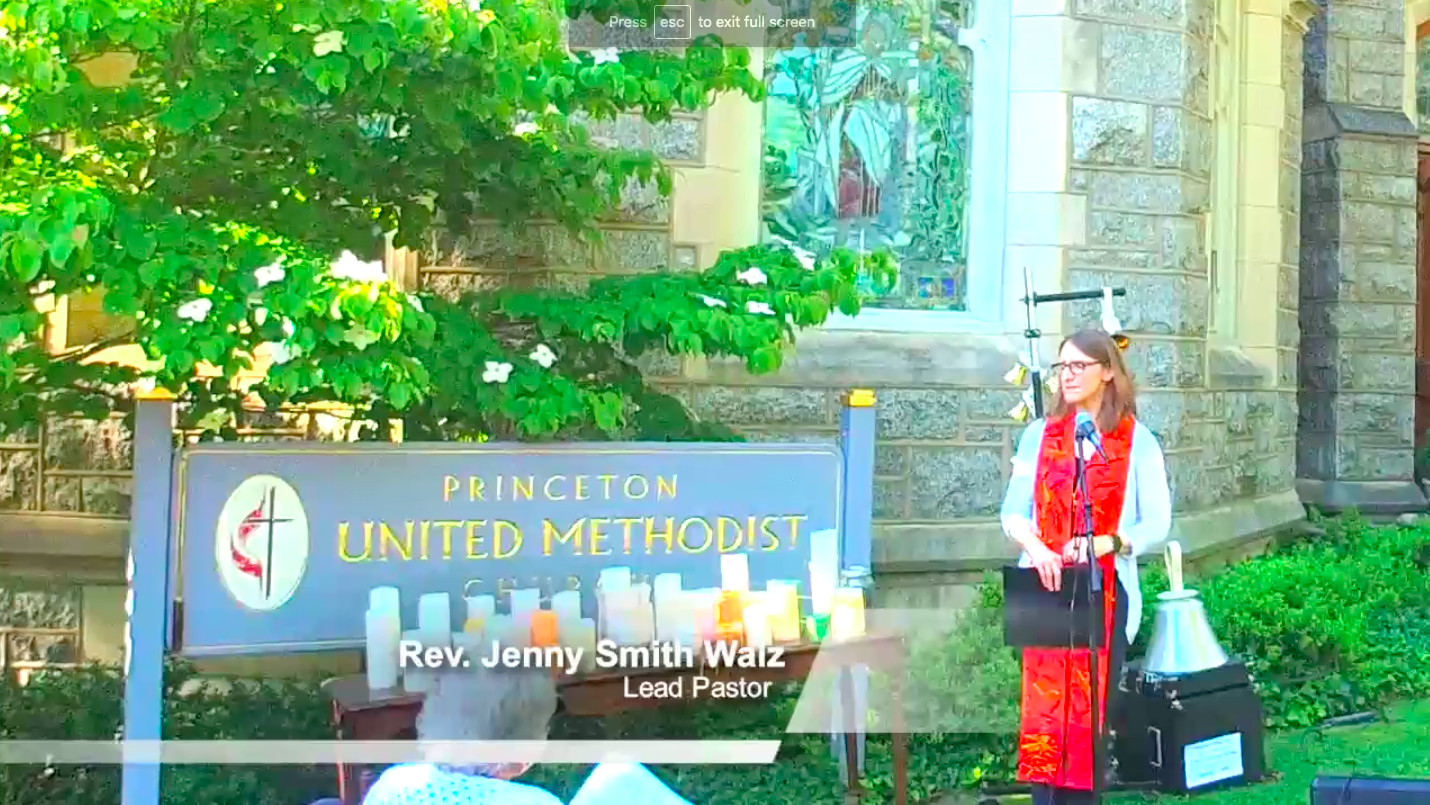
Held on the front lawn of the church, the service began with a Time of Silence and Prayer accompanied by the somber music of bells and ending with a reading of the names of Black men, women, and children victimized by police. Here is a link to the program. 

Pastor Jenny Smith Walz then invited those gathered to “put words to the pain and struggle that has occurred for so long” by sharing their thoughts and experiences with racism.  Many of those who shared think of themselves as caring, as sensitive to the struggles of minorities, but as one volunteer said, “after talking to people of color, I realize racism goes deeper than I ever imagined.”  Another, who grew up in the North during segregation, recalled visiting friends in the South when she was a young woman. Getting off the bus she saw on the water fountain the sign Whites Only. “I never talked about what I saw with my friends during that visit, but I returned home realizing how my Black friends must have felt,” she said.

Evangeline Burgers warned against complacency, saying “You can get comfortable reading books [about racism] and going to rallies; you can start to think ‘I am doing something.’ I pray that I don’t let a day go by that I forget my white privilege.”  Princeton UMC’s director of children’s ministry closed with a fervent prayer” “Don’t let the fires in our hearts tonight be extinguished.” 

Pastor Ginny Cetuk closed the sharing witness part of the service by acknowledging that racism is tolerated in society and our institutions – even the church.  “These have been a challenging and frightening few weeks, and I  get so very discouraged.  But I also realize that I am not alone, that together, we can make significant change.”

As the service moved toward its conclusion, Pastor Jenny challenged those there and those watching virtually to continue to explore and study our own part in contributing to racism in our communities and to pray for guidance observing that “prayer can feel like a wih we put up to Heaven, but prayer creates space in us for God to come in, for the Holy Spirit to show what we need to understand about ourselves.” As she spoke, she picked up a glass jar that had been filled with beans, a Witness Jar.  “Thirty-seven million Black people live in the United States.  Take a jar, a cup, any container and gather these 37 million represented by beans, buttons, coins; say their names as you pray and find a way to keep them in front of us,” she asked.

Prayer and work to end racism can continue. To access resources – and to contribute resources you have found, go to this link on PrincetonUMC.org.)


Recommended Reading: Gregg Louis Taylor

Meet Gregg Louis Taylor, author of Here, Now, with You, subtitled ‘Six Movements of Compassion for Life and Leadership.

Taylor’s book is described by the publisher, Abingdon Press.

Grounded in the real-life context of experience and the encouragement of relatable stories, plus providing an interactive process for meaningful conversations, reflection, and application, two questions shape the book’s content:

1. What every day experiences open the door to compassion’s movement in our lives?

2. How do we recognize and embrace such encounters to cultivate rich expressions of “compassionating” lives and leadership?

By learning to be compassionate just as God is, we become more authentically connected to one another and expand our awareness of the God who is always here.